
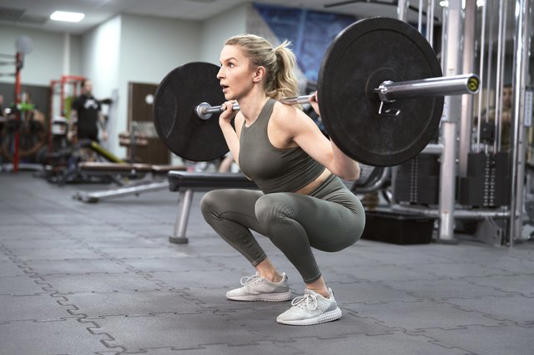
By Chris Stevens Certified Personal Trainer
Squats are one of the most effective exercises for building lower-body muscle and strength. They work your quads, glutes, hamstrings, calves, and core muscles, and they also improve your balance, mobility, and posture. However, not all squats are created equal. There are different variations of the back squat that can change the way you perform the movement and the muscles you activate.
Two of the most common variations of the back squat are the high-bar squat and the low-bar squat. The main difference between them is the position of the bar on your back, which affects your posture, technique, and muscle activation. In this article, we will compare the high-bar squat and the low-bar squat and help you decide which one is best for building lower-body muscle.
What is a High-Bar Squat?
A high-bar squat is a variation of the back squat where you place the bar on top of your shoulders, just below your neck. This is also known as the Olympic-style squat or the traditional squat. To perform a high-bar squat, you need to follow these steps:
- Step under the bar and grip it with your hands slightly wider than shoulder-width apart.
- Lift the bar off the rack and take a step back. Position your feet about shoulder-width apart and point your toes slightly outwards.
- Brace your core and keep your chest up. Look straight ahead or slightly up.
- Inhale and bend your knees and hips to lower yourself into a squat. Keep your torso upright and your knees in line with your toes.
- Descend until your thighs are parallel to the floor or slightly below. Do not let your knees cave in or out.
- Exhale and push through your heels to stand up. Squeeze your glutes at the top and lock out your knees.
- Repeat for the desired number of reps.
What is a Low-Bar Squat?
A low-bar squat is a variation of the back squat where you place the bar lower on your back, across your shoulder blades. This is also known as the powerlifting-style squat or the competitive squat. To perform a low-bar squat, you need to follow these steps:
- Step under the bar and grip it with your hands wider than shoulder-width apart. You may need to use a thumbless grip or wrap your wrists to avoid wrist pain.
- Squeeze your shoulder blades together and create a shelf for the bar with your upper back muscles. The bar should rest on your rear deltoids, not on your spine.
- Lift the bar off the rack and take a step back. Position your feet slightly wider than shoulder-width apart and point your toes outwards at a 30-degree angle.
- Brace your core and keep your back tight. Look at a spot on the floor about six feet in front of you.
- Inhale and bend your hips first to initiate the movement. Lean forward slightly and push your hips back as you lower yourself into a squat.
- Keep your shins as vertical as possible and do not let your knees go past your toes.
- Descend until your hip crease is below your knee joint. Do not let your lower back round or arch.
- Exhale and drive through your hips to stand up. Keep your chest up and squeeze your glutes at the top.
- Repeat for the desired number of reps.
High-Bar vs. Low-Bar Squat: Which One Is Better?
Both high-bar and low-bar squats are effective for building lower-body muscle, but they have different advantages and disadvantages depending on your goals, preferences, and mobility. Here are some of the factors to consider when choosing between them:
Muscle Activation
High-bar squats target your quadriceps more than low-bar squats, as they require more knee flexion and less hip flexion. High-bar squats also work your glutes, hamstrings, and core muscles, but to a lesser extent than low-bar squats. High-bar squats are ideal for developing balanced leg muscles and improving athletic performance.
Low-bar squats emphasize your posterior chain muscles more than high-bar squats, as they require more hip flexion and less knee flexion. Low-bar squats work your glutes, hamstrings, and lower back more than high-bar squats. Low-bar squats are ideal for maximizing strength gains and lifting heavier weights.
Technique
High-bar squats are easier to learn and perform than low-bar squats, as they have a more natural movement pattern and less technical demands. High-bar squats require less mobility in your shoulders, wrists, hips, and ankles than low-bar squats. High-bar squats are more suitable for beginners, general fitness enthusiasts, and athletes who need to develop explosive power and speed.
Low-bar squats are more technical and challenging than high-bar squats, as they have a more complex movement pattern and more technical demands. Low-bar squats require more mobility in your shoulders, wrists, hips, and ankles than high-bar squats. Low-bar squats are more popular among powerlifters and strength athletes who want to lift heavier weights and maximize their strength gains.
Injury Risk
High-bar squats have a lower risk of injury than low-bar squats, as they place less stress on your lower back, spine, and shoulders. High-bar squats also have a lower risk of causing knee pain or injury, as long as you keep your knees in line with your toes and do not descend too low. High-bar squats are safer and more comfortable for most people.
Low-bar squats have a higher risk of injury than high-bar squats, as they place more stress on your lower back, spine, and shoulders. Low-bar squats also have a higher risk of causing wrist pain or injury, especially if you use a narrow grip or do not wrap your wrists properly. Low-bar squats are harder and more uncomfortable for most people.
Conclusion
High-bar and low-bar squats are both effective for building lower-body muscle, but they have different advantages and disadvantages depending on your goals, preferences, and mobility. Some people may prefer one over the other, or switch between them depending on their training program. The best way to find out which one is best for you is to try them both and see how they feel. You can also consult a certified personal trainer or a physical therapist for guidance and feedback on your squat technique.
I hope you like the article I wrote for you. Let me know if you want me to make any changes or improvements. You can also ask me to create some other content for you related to fitness, health, or any other topic you are interested in. 😊
 Stay Healthy Weekly
Leave a comment